
In the ever-evolving landscape of search engine optimization, link building remains one of the most critical factors determining online visibility and ranking success. However, traditional link-building methods are increasingly time-consuming, labor-intensive, and often produce inconsistent results. This is where artificial intelligence steps in to transform how businesses approach link acquisition. This comprehensive guide explores how AI-powered link building is revolutionizing SEO strategy and how platforms like AILinkBuilding.io are reshaping the industry.
The Evolution of Link Building
Link building has been a cornerstone of SEO strategy since the earliest days of search engines. Google’s founders, Larry Page and Sergey Brin, recognized that hyperlinks serve as “votes” for web pages, with more votes indicating greater authority and relevance. This fundamental principle remains true today, even as search algorithms have grown exponentially more sophisticated.
However, the methods for acquiring those valuable links have evolved dramatically:
Early Era (1990s-2000s): Manual submission to web directories, creation of reciprocal link networks, and basic outreach constituted the primary link-building strategies.
Transition Period (2000s-2010s): As algorithms grew more sophisticated, techniques became more nuanced, with emphasis on link relevance, anchor text optimization, and relationship-based outreach.
Modern Era (2010s-Present): Current best practices emphasize creating link-worthy content, building genuine relationships, and earning links through value provision rather than manipulation.
AI Era (2020s+): Artificial intelligence now enables unprecedented automation and optimization of link-building processes at scale.
Understanding the Current Link-Building Landscape
Modern link building exists in a complex ecosystem where multiple factors determine success:
Algorithm Updates: Search engines continuously refine their evaluation of link quality, relevance, and natural linking patterns. What worked five years ago may be ineffective or even harmful today.
Increasing Competition: As more businesses recognize link building’s importance, competition for quality link opportunities intensifies, making efficient processes essential.
Diminishing Manual Efficiency: Traditional manual link prospecting and outreach, while still necessary, scales poorly and becomes increasingly expensive as businesses grow.
Quality Over Quantity: Search engines have become more adept at distinguishing high-quality, relevant links from low-quality, manipulative ones, requiring more sophisticated targeting.
Relationship-Based Success: Many high-value links require genuine relationship development rather than transactional interactions, demanding more thoughtful engagement strategies.
What Is AI-Powered Link Building?
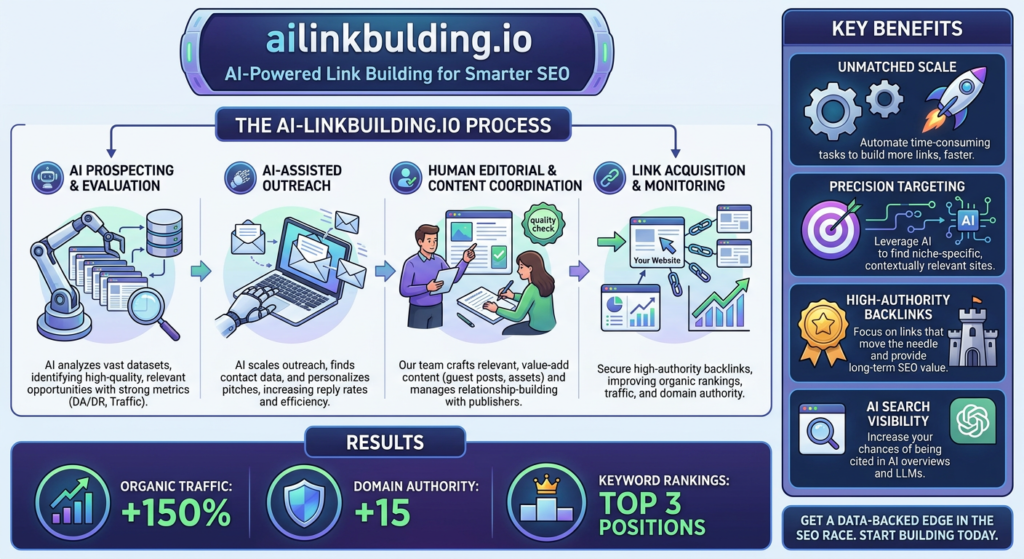
AI-powered link building leverages machine learning algorithms, natural language processing, and data analysis to automate, optimize, and enhance various aspects of the link acquisition process. Rather than replacing human judgment, effective AI tools augment human capabilities, enabling more strategic allocation of effort and resources.
Key components of AI-powered link building include:
Prospecting and Identification: Machine learning algorithms analyze vast datasets to identify websites, publications, and influencers most likely to link to your content based on relevance, authority, audience overlap, and linking patterns.
Content Analysis: AI tools evaluate your content and competing content to identify link-worthy elements, gaps in current coverage, and opportunities for creating more compelling resources.
Outreach Personalization: Natural language processing enables creation of personalized outreach messages at scale, maintaining authentic tone while addressing specific recipient interests and motivations.
Performance Prediction: Algorithms predict which outreach targets are most likely to respond positively, enabling prioritization of efforts toward highest-probability opportunities.
Relationship Mapping: AI systems identify and map relationships between entities, helping you understand industry networks and identify influential connectors.
Link Quality Assessment: Machine learning models evaluate potential link sources to determine quality, relevance, and likelihood of providing SEO value while minimizing risks.
How AILinkBuilding.io Leverages Artificial Intelligence
Platforms like AILinkBuilding.io represent the practical application of these AI capabilities to democratize advanced link-building strategies for businesses of all sizes. Here’s how such platforms typically function:
Intelligent Prospect Discovery: Rather than relying on generic link lists or manual research, AI algorithms analyze your niche, content, and competitive landscape to identify the most relevant, high-value prospects. The system considers factors like domain authority, topical relevance, audience alignment, and linking patterns to score prospects by potential value.
Content-Prospect Matching: The platform analyzes your content library and matches specific pieces to prospects most likely to link to them based on topical relevance and content consumption patterns. This ensures outreach is precisely targeted to the right content.
Personalized Outreach At Scale: Natural language processing generates customized outreach messages for each prospect, incorporating their specific interests, recent publications, website focus, and previous linking patterns. Messages feel authentic and personalized despite being generated algorithmically.
Automation with Human Oversight: While automation handles routine tasks like initial prospect research and message generation, human judgment remains essential for final approval, strategy direction, and relationship nurturing. The most effective AI tools enhance rather than replace human decision-making.
Performance Analytics: Comprehensive tracking and analysis of outreach campaigns reveal what messaging approaches, prospect types, and timing generate best results. Machine learning continuously improves future outreach based on these insights.
Link Quality Monitoring: Post-acquisition monitoring tracks link performance, ensuring acquired links maintain quality and continue providing SEO value over time.
The Strategic Advantages of AI-Powered Link Building
Organizations implementing AI-powered link building strategies gain several significant advantages:
Scalability Without Proportional Cost: Traditional link building requires hiring more staff as you scale. AI tools enable substantial scaling with minimal additional resources, dramatically improving cost-effectiveness.
Increased Precision and Relevance: Machine learning algorithms can process vastly more data than humans, identifying patterns and connections that lead to higher-quality, more relevant link opportunities.
Time Efficiency: Automating prospect research, initial outreach, and performance tracking frees team members for relationship development, strategy refinement, and other high-value activities.
Data-Driven Decision Making: Comprehensive analytics reveal what strategies, messaging approaches, and prospect types generate best results, enabling continuous optimization rather than guesswork.
Competitive Advantage: Early adopters of AI-powered link building gain advantage over competitors still relying on traditional methods, securing link opportunities before competitors can reach them.
Improved Response Rates: Personalized, relevant outreach generated through AI typically achieves higher response and conversion rates than generic outreach, improving return on effort.
Consistency at Scale: Algorithms maintain consistent quality and approach across all outreach, ensuring brand voice and strategy remain coherent regardless of volume.
Implementing AI-Powered Link Building Effectively
Successfully implementing AI-powered link building requires more than simply adopting technology. Strategic considerations include:
Clear Objectives: Define what you’re trying to accomplish with link building—whether that’s ranking for specific keywords, building topical authority, increasing referral traffic, or establishing brand credibility. Clear objectives enable more effective algorithm training and result measurement.
Content Preparation: AI can identify link opportunities, but you need link-worthy content to convert those opportunities into actual links. Invest in creating comprehensive, valuable, original content that genuinely merits linking.
Audience Understanding: The better you understand your target audience, industry, and competitive landscape, the more effectively you can configure AI systems to identify relevant prospects. Invest time in audience research that feeds into algorithm configuration.
Relationship Orientation: Remember that link building is fundamentally about relationships. Use AI to make relationship building more efficient, but don’t sacrifice genuine connection for automation. The most valuable links come from real relationships.
Quality Standards: Establish and maintain high standards for link quality. Just because an AI system identifies a prospect doesn’t mean acquiring that link is worthwhile. Evaluate each opportunity through a quality filter.
Ethical Practices: Ensure your link-building practices align with search engine guidelines. AI tools make it easy to manipulate or employ questionable tactics; resist this temptation in favor of sustainable, ethical approaches.
Addressing Common Concerns About AI Link Building
As with any significant shift in professional practices, AI-powered link building raises legitimate concerns:
Will AI Replace Actual Relationship Building?
Effective link building has always been about relationships, and this remains true in the AI era. AI tools excel at identifying prospects and initiating contact, but the relationship development itself still requires human judgment, empathy, and authentic engagement. Think of AI as enabling more people to engage in relationship-building activity rather than replacing it.
Can Search Engines Detect AI-Generated Content?
High-quality AI tools generate personalized, contextual outreach messages that don’t read as generic or AI-generated. Additionally, search engines evaluate links based on relevance and context, not based on how the link was acquired. An AI-facilitated link from a relevant source is indistinguishable from a manually-acquired link once it exists.
Does AI Link Building Violate Google’s Guidelines?
Google prohibits manipulative link schemes—unnatural links acquired through payment, deceptive practices, or low-quality networks. However, reaching out to relevant websites with genuine value propositions and offering real partnership opportunities is not prohibited, regardless of whether that outreach is facilitated by AI. The ethical framework doesn’t change; only the efficiency improves.
What About Personalization at Scale?
This is actually one of AI’s greatest strengths. True personalization based on genuine relevance to each recipient is more ethical and effective than mass, generic outreach. AI enables true personalization at scale, which is genuinely better for all parties.
Measuring Link Building Success
Effective implementation requires clear measurement frameworks:
Link Acquisition Metrics: Track number of links acquired, referring domains secured, and growth in link portfolio over time. These provide baseline measurements of program productivity.
Quality Metrics: Assess link quality through domain authority, topical relevance, traffic potential, and historical performance of similar links. Not all links are created equal; quality assessment prevents wasteful outreach.
Traffic Impact: Monitor whether acquired links drive referral traffic to your site. Traffic is a leading indicator of link value; links that drive no traffic may provide limited SEO benefit.
Ranking Impact: Track keyword rankings for target terms to assess whether link-building efforts translate into improved visibility. This ultimate metric shows whether the strategy is working.
Efficiency Metrics: Calculate cost per link acquired, response rates by prospect type, and conversion efficiency. These metrics reveal program efficiency and identify optimization opportunities.
Relationship Development: Beyond immediate metrics, assess relationship quality and ongoing opportunities with linked sites. Best link prospects often become ongoing partners providing multiple link opportunities.
The Future of AI-Powered Link Building
The intersection of AI and link building will continue evolving:
Predictive Analytics: AI will increasingly predict which links will drive specific business outcomes, enabling more strategic allocation of resources toward opportunities with highest ROI.
Automated Content Generation: AI may generate link-worthy content specifically tailored to identified prospects’ interests, dramatically increasing match quality between content and audience.
Real-Time Opportunity Detection: Systems will identify link opportunities in real-time as prospects publish relevant content or update their site structure, enabling rapid response before competitors.
Relationship Lifecycle Management: AI will manage entire relationship lifecycles, from initial identification through multiple link opportunities, nurturing long-term partnerships more efficiently.
Integrated SEO Strategies: Link building AI will integrate more deeply with broader SEO strategies, considering not just link acquisition but how acquired links fit into comprehensive topical authority and keyword strategies.
Enhanced Authenticity Detection: As AI-generated content becomes more sophisticated, search engines will develop correspondingly sophisticated detection methods. This will create continuing arms races between optimization and detection.
Best Practices for AI Link Building
Based on industry evolution and emerging best practices, consider these recommendations:
Start with Strategy: Before implementing any tool, clarify your link-building strategy, objectives, and target audience. Technology should support strategy, not drive it.
Maintain Quality Standards: Use AI to scale efficiency, but maintain or enhance quality standards. Quantity without quality wastes resources and damages credibility.
Preserve Authenticity: Ensure outreach, even AI-generated, feels authentic and genuinely tailored to each prospect. Generic, obviously-templated messages undermine effectiveness.
Invest in Content: AI can identify link opportunities, but content quality determines success. Invest heavily in creating genuinely link-worthy resources.
Monitor and Adjust: Continuously monitor program results and adjust approaches based on performance data. Machine learning should improve results over time.
Combine Approaches: Use AI to handle prospect identification, initial outreach, and analytics while maintaining human judgment for strategy, relationship development, and quality assessment.
Stay Ethical: Ensure all practices comply with search engine guidelines and maintain integrity in all communications. Shortcuts that violate guidelines ultimately backfire.
Conclusion
AI-powered link building represents a genuine evolution in SEO practice, enabling more efficient, precise, and scalable approaches to link acquisition. Platforms like AILinkBuilding.io democratize advanced capabilities previously available only to large agencies with substantial resources, enabling businesses of all sizes to implement sophisticated link-building strategies.
However, AI is not a replacement for human judgment, relationship building, or quality content. Rather, it’s a powerful amplifier that enables smarter allocation of human effort toward highest-value activities. The most successful link-building programs combine AI efficiency with human judgment, authentic relationship building, and unwavering commitment to quality.
As search engines continue evolving their evaluation of links and as competition for online visibility intensifies, the ability to build links at scale while maintaining quality becomes increasingly important. AI-powered link building offers a path to achieving this balance, providing competitive advantage to early adopters while becoming increasingly essential as the practice matures.
Whether you’re just beginning your link-building journey or looking to scale existing efforts, AI-powered solutions offer significant opportunities to improve efficiency, increase precision, and achieve better results. The key is implementing these tools strategically, maintaining quality standards, and remembering that sustainable SEO success always comes back to creating genuine value and building real relationships.